There is now a highly conscious effort among the citizenry to effect the societal changes that they want without government or less government assistance.
This, I believe, is the right path to take.
Less government means less public funds to spend. More people participation means more growth in the democratic sector. The more people involved in nation-building, the greater chances are, of a speedy recovery of government.
People power people is a concept which sprung from the experiences of Filipinos in EDSA 1986. Former president Cory Aquino took part in this great enterprise. Her untimely death has not waned the people's desire to partake in Nation-building, however small those contributions are.
Atty. Alex Lacson's book " 12 Little Things Every Filipino Can Do To Help Our Country" is a veritable new Filipino kartilla. It talks about how ordinary Filipinos can accomplish great things by doing small ones.
Every single Filipino doing these small ones must consider himself part of the great Patriotic enterprise. By doing your share in Nation-building, you automatically become a Patriot.
A Patriot, by transliteration, means "bayani". Bayani is not "hero" when transliterated in English. Our concept of a "bayani" is more akin to Patriot than hero. Besides, heroes, according to Western concepts, are usually people who does things in historical spurts. While Patriots are living heroes, always doing the right things as a Citizen every single day of their lives.
If you believe in this, it is now time for us to abandon calling our fellow Filipino "kabayan" since the concept just means "my fellow Filipino born in the Philippines, the land of our births".
It is time for us to call every Filipino "kabayani" or fellow Patriot or compatriot. We are all Patriots, all those who believe that the responsibility lies in every Filipino, not just with government, when Nation-building is involved.
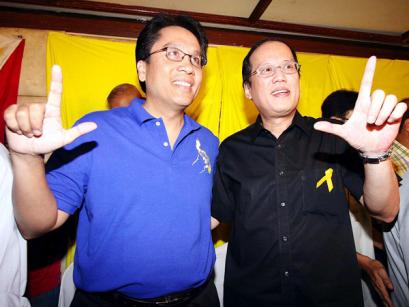
Noynoy Aquino's new administration promises to be a true catalyst for change in our country. This administration, I really hope, would measure up to the high expectations set by the Filipino People. Aquino should just stay and remain focus at the task at hand and avoid any distractions.
For the past decades, no post-Marcos regime has ever successfully retained the public's approbavation mainly for just one (1) reason---it fails to unite the Filipino People behind it. Cory Aquino had that chance, but because of numerous attempts against it, it lost focus and strayed at the task at hand.
The Ramos administration did nothing to unify and concentrated on improving the economy. Its successor, the short-lived Estrada administration, tried to implement a mass-oriented or masa-centric regime, only to fail, and fail miserably.
The Arroyo regime, meanwhile, toyed with the idea of a "strong Republic." What happened was entirely the opposite.
I dare say that Aquino should implement a state-wide information campaign that focuses on one thing---unification of the Nation.
Aquino must operationalize the Ideals of EDSA. What is really the operational meaning of the first EDSA revolt?
Historically, there are two (2) interpretations of the meaning of EDSA, the first one is it is the one thing resorted to by counter-elites whenever they want to pressure government to accede on some hair-brained idea or proposal they have. Meaning, when a crisis crops up, the usual battlecry of those aggrieved is simply "go to EDSA."
The interpretation of EDSA should go beyond its traditional concept as a "last resort prior to armed struggle."
The second interpretation of EDSA is its a coup d'etat of the elite, a means to perpetuate power within the confines of the differing elite groups dominating Philippine society. This is why, each and every time, people hear of "EDSA", the usual voices demanding it came from the elite ranks. Look at each and every EDSA photo, and you'll always see the usual faces of aristocrats and technocrats cum activists there.
This new administration should re-define the morphology of the concept and push for the institution of the operational meaning of EDSA.
EDSA should be interpreted in its purest form---EMPOWERMENT OF THE PEOPLE. How do you empower the people?
BY ACTIVELY ENGAGING THEM IN THE AFFAIRS OF GOVERNMENT. How do you do that?
BY implementing a STATE ideology which centers on people's empowerment. Engagement should focus more on making people realize that they have (1) a responsibility to be part of Nation-building and (2) that each and every one is a KA-BAYANI, a co-patriot.
Ka-Bayani-han should be re-defined as what it truly is---collective-wide cooperation. The graphical representation or image of a few Filipinos carrying a nipa hut in its shoulders should be interpreted in a new light. The nipa hut should be used as an image symbolising the Nation, and the people carrying it on their shoulders should actually be interpreted as the entire Filipino People being the true and responsible builders of the Nation.
As a state ideology, Kabayani-han should emphasize that every Filipino citizen is responsible for the fate and direction of the country. That every one is a catalyst, just waiting to be tapped.
Likewise, every Filipino should be called "Ka-Bayani" meaningful of the concept of shared responsibility or shared Nationalism.
Aquino should adopt this as a continuation of his struggle. It is very apt for him considering that he is the prime example of being a Ka-Bayani. One, he is a scion of a great family of heroes (his parents are this Nation's martyrs) and two, he ran under the platform of "people power".